It has been twelve years since LEED v4 was introduced, and six years since v4.1 rolled out. On April 28th, 2025, LEED v5 was launched, which includes guides for Existing Buildings, Commercial Interiors, and Building Design + Construction (Core & Shell/New Construction) rating systems. LEED v5 is generating excitement across the Architecture, Engineering, and Construction (AEC) community for its expanded focus and forward-looking updates.
LEED v5 incorporates several LEED v4/v4.1 credits into prerequisites. Projects targeting Platinum certification must also satisfy additional prerequisite criteria. The New Construction Platinum Certification requirements can be found here.
Gone are the days of putting together a design-bid-build LEED project. To achieve LEED v5, it’s best to start with the whole project team discussing opportunities before design starts. This includes architects, engineers, the general contractor and the MEP trade partners. This approach puts emphasis on selecting your general contractor early.
Building owners and developers want to limit preconstruction costs but—similar to finding early issues through modeling efforts—getting all players to the table early provides opportunities to save time and money later during construction.
Understanding The Goals
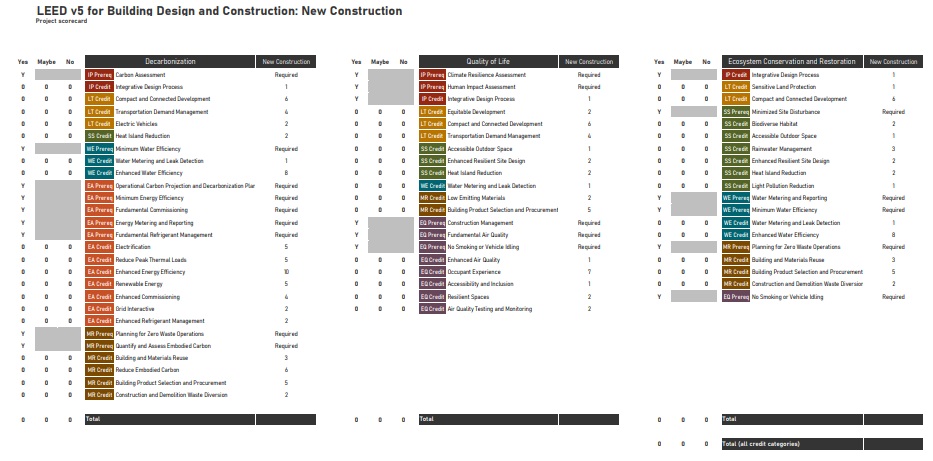
LEED v5’s innovations bring a focus to three central areas of impact: Decarbonization, Quality of Life, and Ecological Conservation and Restoration. This is a significant shift in focus areas from previous versions. LEED v5 takes a much-needed holistic approach to the built environment and creates greater thought leadership through design and advanced planning requirements.
Reviewing the prerequisites and understanding how they incorporate into your project is the first step. USGBC has a v4 to v5 Summary of Changes for BD+C New Construction and Core & Shell, ID+C Commercial Interiors, and O & M Existing Buildings available for free on their site.
Decarbonization
LEED v5 places a strong emphasis on decarbonization, requiring Carbon Assessments and an Operational Carbon Projection and Decarbonization Plan for New Construction and Core & Shell projects. For Interiors projects, Estimated Energy Use and Operational Carbon Projection are prerequisites. The Operations and Maintenance certification now requires an Operations Assessment and Policy criterion, along with a Carbon Projection from Energy Use prerequisite. V5 presents a multitude of options to help teams reduce their carbon impacts, regardless of project type. Understanding a facility’s carbon impact is the first step in reduction.
Quality of Life
New to LEED v5 is the full actuation of a plan to improve the quality of life of those in or around a LEED building. One Quality of Life component is the Climate Resilience Assessment, which is a prerequisite for each of the project types. This drives project teams to review, research, and identify a minimum of two priority hazards and assess their potential impacts to the building, its future occupants, and to the site during construction. Understanding a project’s future hazards provides an opportunity to design for occupant safety and helps create an outline for increasing the life expectancy of the building.
Ecological Conservation and Restoration
This impact area looks at familiar LEED credits like Sensitive Land Protection, Low Emitting Materials, and Rainwater Management. It also provides new areas that building owners may want to investigate.
The Human Impact Assessment is a prerequisite that helps project teams understand the social construct of the regional community, along with worker availability and local supplier availability. The goal is to address potential social inequities. This component looks at various data sets like demographics, local infrastructure and land use, while also offering methods to provide positive influence on health impacts and occupant experiences.
A new addition benefiting building owners is the Green Lease credit. There are three options to this credit, which helps tenants incorporate high-performance materials and systems into their spaces, ensuring owner investments are protected for years to come. Note: Green Leases are also known in the CRE industry as High Performance Leases.
The Benefits
Assuming the goal of the project is to create a built environment that has a lower carbon footprint, a reduced operating expense, and is a benefit to the local community, then LEED v5 is absolutely worth embarking upon. The US Green Building Council is once again leading the efforts to make positive changes in our built environment. LEED v5 achieves this through its thoughtful organization and intuitive processes.
For more information, you can download the free LEED v5 Reference Guides Below:
About the Author

Laura Soma, LEED AP BD +C, LFA
Laura has over 29 years in the construction industry and is the Sustainability Manager at GLY Construction – guiding corporate sustainability initiatives and supporting project-specific goals with a whole-systems perspective. She leads GLY’s Sustainability Advisory Group and contributes to numerous professional organizations through regular committee involvement including Sustainable Construction Leaders through Green Commons, is a Board member and on the Education Committee of the Bellevue and Seattle 2030 Districts, is a Leadership Advisory Board Member of the Construction Center of Excellence and most recently, has joined the NAIOP Sustainable Development Committee.
Laura’s background in Project Management enables her to see the big picture and enhances her ability to make positive changes on the job sites. Her passion for steering the construction industry towards an environmentally-sound future is grounded in her belief that it is our responsibility to care for our planet, making it better for the next generation.